What a Customer Stories Page Needs That Most Corporate Film Pages Skip
A customer stories page has to show a real person in a real situation before it shows a logo. Most corporate film pages skip that, and it shows.

A customer stories page has to show a real person in a real situation before it shows a logo. Most corporate film pages skip that, and it shows.
A customer stories page needs a customer's problem on screen before it needs a logo, a grade or a music bed. Most corporate film pages skip that, and the skip is the reason the page reads like a brochure with a play button. A promise of evidence is what the page is making, and the first ten seconds either keeps the promise or breaks it.
The page is a promise, not a portfolio
A viewer who lands on a customer stories page is not there to admire your work. They are there to find out whether anyone like them has already been through the thing they are about to buy, and whether that person will say so in their own words. That is the whole transaction. If the page cannot put a named person, a recognisable situation and a sentence in that person's own voice in front of a stranger in the first few seconds, nothing below it matters, because the stranger has already filed the page under advertising.
Most corporate film pages fail this test quietly. They open on a logo, then a skyline, then a slow push through a lobby, then a title card in a typeface the brand team approved. The customer arrives at minute two, smiling, saying something about partnership. Evidence is somewhere in there, but the viewer has to work for it, and viewers do not work.
The test is simple. Show the page to someone who does not trust you yet and ask them to find the customer's own words and the customer's own situation. If they have to scrub, the page is a portfolio. A portfolio shows what you can make. A customer stories page shows what happened to someone.
A case study is not a story
A case study is a document. It has a challenge, a solution, a result, a pull quote, and a PDF link. It is useful, it is written in the third person, and nobody has ever watched one twice. Customer story video is a different object: it is a scene with a person in it, and the person is doing the thing they actually do. The difference is not production value. It is whether there is a human being in a room, at a desk, on a floor, with a problem that existed before your product arrived.
The production task is to find the scene the customer already lives in. Not to invent one, not to stage a more cinematic version of one. If the customer works in a control room, the scene is the control room at the hour when it is busy. If the customer runs a workshop, the scene is the bench, the tools, the half-finished piece. You do not need to make the scene look like anything. You need to get to it before the light goes.
This is where corporate film pages get it backwards. They commission a story and then build a set for it. In a glass meeting room with a plant in the corner, the customer ends up talking about transformation. The actual room, the one with the cables and the shift chart on the wall, stays off camera. The page then wonders why the film feels interchangeable with every other film on every other page.
A customer is not a case study with a face. A customer is a person with a Tuesday.
The first frame has to be the problem
Open on the customer's situation, not on the brand. Hands on a keyboard with a screen full of the thing that used to take three days. A desk with two phones on it. A factory floor where the line is running and someone is watching a gauge. A loading bay at six in the morning. The viewer does not need to be told what the problem is in the first frame. They need to see that a real place with real constraints exists, because that is what makes the next ninety seconds credible.
People miss the edit consequence, which is the part that matters. If the claim lands before the viewer has decided to care, they will accept it as context. If the claim lands after a logo and a music sting, they will reject it as a pitch. The first frame is doing the work that the script cannot do, and it is doing it before anyone has agreed to listen.
Here is the analogy I use when a client wants to open on the building. In a documentary, you do not start with the narrator telling you the town is poor. You start with the town. The narrator can arrive later, once you have seen the street. A customer story works the same way, except the narrator is the customer and the street is their workload.
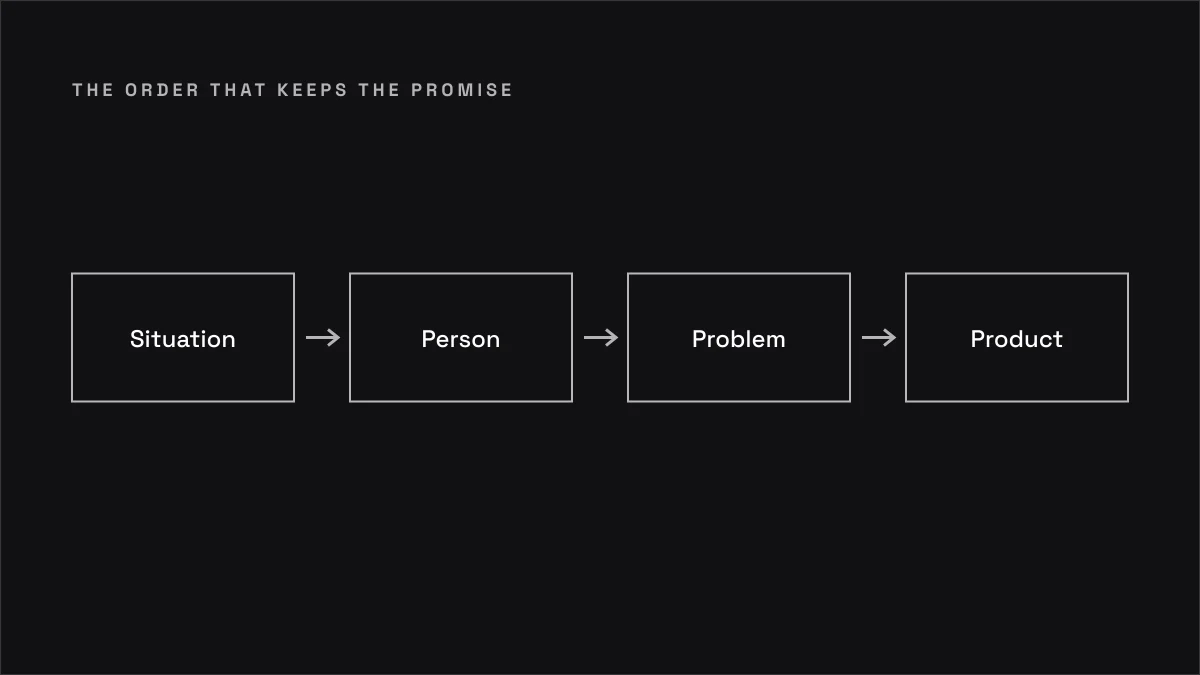
So the order is: situation, person, problem, then product. If the product appears in the first five seconds, the page has told the viewer it is an advertisement, and the viewer will believe it.
Ask the question that makes the customer talk
Harder than any setup, the interview is the hard part of this format, and most of the damage happens before the camera rolls. The instinct is to ask about benefits: what has changed, what has improved, what would you tell a peer. Those questions get answers that sound like the press release, because the customer has been asked them before and has learned the safe shape. Ask instead for the before. What did the week look like before this? Who was chasing whom? What broke? Walk me through the last time it went wrong.
Specific beats broad every time. "Tell me about the Monday when the report was late" will get you a scene. "Tell me about the impact on your organisation" will get you a sentence that belongs on a slide.
The trap is letting the client write the questions. It is a reasonable request and it comes from a reasonable place, but a marketing team writes questions to confirm an approved message, and an approved message is the opposite of a confession. The client's marketing team decides the approved claims. That is their authority, not mine, and I do not argue with it. What I argue for is the right to ask for the before in the room, and to let the customer answer in their own words, with the understanding that nothing leaves the edit without sign-off.
Ask for the before, and then shut up. After a good answer, the silence is where the second sentence comes from.
Shoot the evidence, not the endorsement
B-roll on a customer story is not decoration. It is the proof that the interview is describing something real. The screen with the actual interface on it, filmed at an angle that shows the work and not the logo. The hand on the machine. The tool being picked up and put down. The whiteboard with the old process still on it, half erased. The documentary cutaway exists for exactly this reason: it lets the viewer verify what the talking head has just claimed, without a word of narration.
What to avoid is the stock-looking handshake. Two people in a corridor, one handing over a folder, both smiling at a camera they are pretending not to see. Nobody has ever watched that shot and believed anything. It is the visual equivalent of the word "solutions".
This is also where a local crew earns its day rate. A crew that starts the morning already knowing where the useful corners of a plant are, which door the light comes through at four, and who to ask about access does not spend the first half of the shoot discovering the site. On an India production for an overseas agency, that difference is most of the schedule. A crew that has to be walked around the factory floor is a crew that is not filming the factory floor.
Evidence is usually boring. That is why it works.
Cut it so the customer's sentence survives
In the edit, the temptation is to build to the most flattering line. Something generous about the team, the product, the partnership is what the customer says, and that becomes the spine, because it is the line the client will like and the line that makes everyone comfortable. Protect the other sentence instead. The one where the customer names the problem in plain language, even if it is not the most polished thing they said, even if it makes the before sound worse than the approved narrative allows.
That sentence is what makes the page credible. A viewer who has never met this customer will believe a specific admission far faster than they will believe a compliment, because a compliment is what people say on camera and an admission is what people say when they forget the camera is there.
Here is the process, roughly in order, because people ask how the decision actually gets made:
Transcribe the interview and mark every line where the customer names a problem, a delay, a cost or a frustration.
Build a rough cut around those lines first, before any of the positive material goes in.
Show the rough cut to the client's communications lead with the problem lines clearly intact and flagged in the timecode notes.
Let the communications lead decide what is approved and what is not. That is their call, not the editor's, and not mine.
If a line has to go, ask whether it can be replaced with a different true line rather than deleted outright, so the before still exists on screen.
Lock picture only after sign-off, then grade, mix and cut the versions.
The communications lead signs off. Not the editor, not the director, not the agency account manager who likes the music. Knowing that early saves a week.
Vertical, square, and the page as a set of cuts
The customer stories page is not one film. It is a 16:9 hero for the page, a 9:16 cut for the phone, a 1:1 for a carousel, and a set of stills pulled from the same day. Each one is a different frame, and the frame changes what the shot means. A wide shot of a factory floor that reads as scale in 16:9 becomes a band of grey in the middle of a vertical screen, with the interesting part cropped out. A two-shot of an interview that works in landscape has to become a single in 9:16, which means you need a second camera or a second take, because you cannot crop a person out of a conversation and keep the conversation.
What changes when the crop changes is the centre of gravity. In 16:9 the eye goes across. In 9:16 it goes down, and whatever is at the top of the frame had better be worth the trip. Hands survive the crop. Skylines do not. Faces survive the crop if you leave headroom for the platform's interface, which means shooting looser than feels right in the monitor.
The cost is in shooting time, and it is real. You shoot the interview wider than the hero needs, you shoot the hands as a separate setup, you shoot the screen at an angle that will still read when it is a square. None of that is free. A page that wants a hero, a vertical, a square and stills is a two-camera day at minimum, and the schedule has to say so before the crew is booked.
Shoot for the smallest frame first. The hero will survive the trip.
The page needs a producer, not a camera
The gap on most customer stories pages is not gear and it is not the grade. It is the decision to go back and get the customer's own situation on record, in the customer's own room, with enough time to ask for the before. That decision is a production decision, and it is made by a producer, not by a camera. Somebody has to book the day, brief the customer's team on what the interview will feel like, arrange access to the floor, and hold the schedule open long enough for a real answer to arrive.
Real authority here belongs to the customer's communications team, because they decide what can be said and shown, and to the local operator who knows the site, because they decide what is physically possible on the day. A filmmaker who pretends to hold either of those is a filmmaker who will be corrected by both. The useful role is to make the case for the evidence, and then deliver it inside the limits the other two set.
Put the interview where the customer actually works, with their own desk and their own screen behind them. That is not a luxury. It is the cheapest way to make the page believable. The other version, where the approved line wins and the problem line goes, is the one that fills a page and gets watched by nobody. The difference is never the camera.
When to hand it to someone else
There are shoots where the right move is to bring in a production house rather than run it as a one-man band. If the customer story needs three interview units across three Indian cities in one week, hand it to a house with the crews and the fixers already on the ground in each city. If the site is a live plant where a stoppage costs the client serious money, the schedule belongs to their operations team and the local operator, not to me. If the film is for a regulated industry and the claims need sign-off from a legal team before anything is shot, that process needs a producer who does compliance work all day. And if an overseas agency wants a fixed all-in budget with a single point of liability, a production house is better placed to carry that than an independent.
What I can do is plan, crew and deliver the shoot in India so nobody from the client's side has to fly in. Most of the corporate work I shoot for overseas clients happens without anyone from their side travelling. That is a real saving in time and money, and it is the reason the India production service exists.
A page is not a place to keep your films. It is the place a stranger goes to check whether you are telling the truth.