What agencies should put in a motion design brief before work starts
A motion design brief should record decisions, not describe taste. How one vague line in a shot list turns into weeks of revisions, and what to write instead.

A motion design brief should record decisions, not describe taste. How one vague line in a shot list turns into weeks of revisions, and what to write instead.
The first document I ask for on a motion job is the brief. Not the deck. Not the mood board. The brief. Most of the time it arrives with a line in the shot list that reads: opening title, something that feels premium. It sits next to a timecode and a frame size, and nobody who reads it can act on it. A brief written like a wish list produces a quote, a round of guesses, and a revision three weeks later, when the thing that was supposed to feel premium comes back feeling expensive instead. Agencies looking for motion work send these briefs every week, and the same gap shows up in almost all of them.
The line that ruins the week
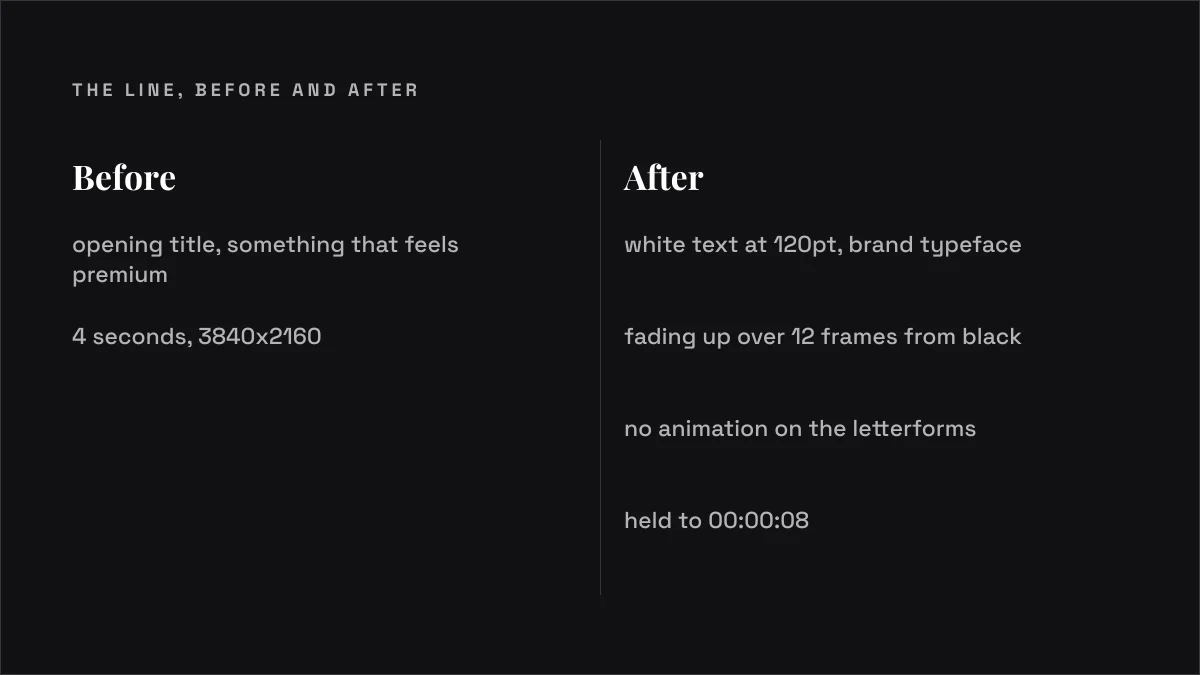
Here is the line, as it turns up in a shot list: 00:00:04, 3840x2160, opening title, something that feels premium, 4 seconds.
What can I do with that? I can make something. I cannot make the thing the client saw in their head. Premium is not a specification. It is a reaction, and reactions are not shared. The client's premium is a thin serif with a long fade. Mine is a hard cut and a held frame. The account manager's premium is the last campaign they liked. Nobody is wrong, and that is the problem.
So I guess, and guessing costs money. A quote built on a guess carries a second version nobody has asked for yet, because the first one is a coin toss. The first cut arrives, the client says it is not quite premium, and we are three weeks in with a revision that was written into the brief before I opened the file.
The fix is embarrassingly small. The line becomes: opening title, 4 seconds, white text at 120pt, set in the brand typeface, fading up over 12 frames from black, no animation on the letterforms, held to 00:00:08, logo lockup bottom left from 00:00:06. Now I can quote it. Now the client can disagree with it before I build it, which is the cheapest moment to disagree.
A brief is a decision, not a description
A brief exists to close questions. That is the whole job. It is not a document that describes taste. It is a document that records decisions so that nobody makes them twice.
Every question the brief leaves open becomes a question someone answers at the worst possible time. Who decides the music? If the brief does not say, the editor picks something, the client hears it, and now you are negotiating taste against a temp track that has already colonised everyone's ear. What is the master ratio? If the brief does not say, the designer builds for 16:9 and the social team asks for 9:16 two days before delivery. What is the delivery codec? If the brief does not say, you get a ProRes file at four in the afternoon and a panicked message about a platform that will not accept it.
None of these are creative problems. They are paperwork problems, and they cost creative time.
The test I apply to any brief before I quote it: read it and count the questions you can answer without asking. If the count is low, the brief is not ready. Sending it out anyway is how you end up comparing three quotes that are not quoting the same job.
Three ways this actually gets made
When an agency needs motion work made, there are three real routes. They are not interchangeable, and the brief has to change shape depending on which one you take.
The first is a motion designer or a small studio. One or two people, a strong reel, a rate, a fast turnaround on a defined piece. You get range and speed. You do not get a full production machine.
The second is a full production house with in-house motion. They can shoot, build graphics, mix sound and deliver a finished master under one roof. You get coverage and a single point of accountability. You pay for the machine whether or not the job needs all of it.
The third is the client's own in-house team. They already know the brand, they are already on the payroll, and for the right job they are the fastest and cheapest option on the list.
Each route answers the same questions differently: who owns the file, who signs off, how revisions behave, what the money looks like, how long it takes. The brief should be written after the route is chosen, not before.
Who owns the file at the end
This is the question agencies forget to ask and then regret. Not who owns the finished video. Who owns the project file that made it.
A small studio will often hand over the After Effects project, the source assets and the fonts, especially if you ask in the brief and pay for the handover. Sometimes they will not, because the project file is their working method and they would rather sell you the next version. Both positions are reasonable. The brief should say which one you are buying.
A full production house is more likely to hold the master file as part of its process. That is not automatically bad. If the house is signing off on the master, holding the project file is part of how they guarantee it. But if the agency needs to make a cut-down in six months without going back to the house, that has to be negotiated up front, and the phrase "source files on delivery" has to be in the brief in those words.
The in-house team wins this one outright. The file never leaves the building. No handover, no licence question, no email in eight months asking for the project file and getting a polite maybe. For quick internal clips, brand refreshes and anything that lives inside the organisation, the in-house team is the correct answer and I am the wrong call.
Where an agency signing off on a motion studio's master file matters is the middle case: the studio builds it, the agency approves it, and the agency's name is on the delivery. Then the agency needs to see the project file, or at least a flattened version with the layers named, before it signs. Signing off on a master you cannot rebuild is signing a blank cheque for the next revision.
How the brief changes for each
Same job, two routes, two briefs. Watch how the scope language moves.
For a small motion studio, the brief is tight and prescriptive. Deliverable: one 30-second 16:9 master, plus one 9:16 cut-down, plus one 1:1 cut-down. Source material: the agency supplies the logo in SVG, the brand typeface, the colour values and all footage graded and delivered as ProRes 4444. Scope: animation of title cards, lower thirds and end card only. No live-action editing. Revisions: two rounds included, further rounds at an agreed day rate. Handover: project file and fonts on final payment. That brief is a set of boundaries. The studio prices against the boundaries, and the boundaries are what make the price predictable.
For a full production house, the same brief reads completely differently. Deliverable: a finished 30-second master, cut-downs, a sound mix and a graded picture, all from one supplier. Source material: the house supplies and manages it. Scope: concept through delivery. Revisions: handled inside the house's own review process. The brief is no longer a set of boundaries. It is a statement of outcome, and the house owns the method. You are buying a result, not a recipe.
Same project. Two documents that share almost no sentences. That is the argument: scope language is not universal. A brief written for a studio and sent to a production house will be read as an insult to the house's process. A brief written for a house and sent to a studio will be read as a blank cheque, and priced like one.
The table agencies should fill in
Fill this in before you send the brief out. If you cannot fill a cell, that is the question the brief still has to answer.
| Dimension | Motion designer or small studio | Production house with in-house motion | Client's in-house team |
|---|---|---|---|
| Lead time | Shortest for a defined piece. Days to a couple of weeks. | Longer. Booking, scheduling and internal review add days. | Fastest if the team is free. Slowest if they are already loaded. |
| Cost shape | Fixed project fee against a defined scope. | Higher, bundled. You pay for the machine. | Already on payroll. Marginal cost only. |
| Revision behaviour | Rounds counted in the brief. Extra rounds cost extra. | Absorbed into the house process, which can mean slower loops. | Whatever the internal calendar allows. Often informal. |
| File ownership | Negotiable. Put it in the brief or lose it. | Usually retained unless agreed in writing. | Retained. No handover needed. |
| Who signs off | The agency, against the studio's master. | The house delivers, the agency approves. | The internal owner, with no external check. |
Read the table down, not across. The route that wins on lead time is not the route that wins on file ownership. That tension is the decision the brief is supposed to record.
Frame rate, ratio and the delivery list
These are the items that get left out of every brief and cause the most friction at the end.
- Master ratio and frame rate. 16:9 at 25fps is not the same job as 16:9 at 24fps, and neither is the same as 9:16. Name the master, then name the cut-downs. Do not leave the ratio to be discovered in the export window.
- Safe areas. Where does the text sit so it survives a 9:16 crop and a platform's interface? Say it in the brief. Platforms overlay their own controls on your frame and they do not ask permission.
- Subtitles. Burned in or as a separate file? Which language? Who writes them? If the answer is "the platform does it", check what the platform does to your type.
- Codec and destination. Where is the file actually going? A broadcast delivery and a paid social upload are different technical jobs. Name the platform, the codec and the file size ceiling.
- Colour. Which colour space is the master in, and who converts it for the platforms that will mangle it anyway?
The delivery list is the least glamorous part of the brief and the one that decides whether the last day is calm or a fire drill. A sensible production office writes the delivery list first and the creative treatment second. The delivery list is the part that cannot be argued with later.
Sound is half the deliverable
Motion work that arrives silent to a mix is a scheduling problem. It looks finished, it is not finished, and the client has already seen it.
Name the sound in the brief. Is there music? Who supplies it, who licenses it, and is it cleared for the platforms you are delivering to? Is there a voice? Who writes the script, who books the artist, who directs the read? Is there a mix, and who is doing it, and does the mix house get the picture locked before or after the graphics are final?
The step people get wrong is assuming the motion vendor owns the sound because the picture and the sound arrive in the same file. They usually do not. The vendor animates to a track you supply, and if you have not supplied one, they animate to a temp track that will be replaced, and every timing decision in the animation is now wrong.
Lock the sound before the animation is timed. That is the whole rule. It costs a day at the front and saves a week at the back.
Where a production house is the right call
A campaign that needs three units running in three cities at once, a shoot that needs a full art department, a schedule that cannot slip because a launch date is fixed: a larger production house with in-house motion is genuinely the better choice. It runs several units at once, and it carries the insurance and the bench depth that a fixed date demands. If what you need is that machine, I am not the right person.
The same goes for a city I am not in. A local crew starts the day already knowing things a flown-in crew spends its first day discovering. If the brief is a two-day shoot in a city where I have no relationships, the local operator is the right hire and I am the unnecessary cost. That is the honest answer.
I have over six years of experience running a production house. That covers a brand film, a documentary, a product launch, a set of cut-downs, planned, crewed and finished in India so nobody on the client side has to fly in. It does not cover three cities in one week. The bigger job belongs to a bigger house, and I will say that before the brief is written, not after.
What the brief cannot fix
Approvals. A brief can name the approver, but it cannot make the approver decide.
If three stakeholders have to agree and one of them joins the review in week four, the brief did not fail. The client's approval structure failed, and no vendor can fix that from the outside. The best I can do is ask, in writing, before the work starts: who signs off, is it one person or a committee, and what happens when they disagree. If the answer is a committee, the brief should say so, and the schedule should carry the cost of it.
Single points of feedback matter for the same reason. One consolidated set of notes per round, from one named person, is worth more than any clause about revisions. Ten people sending notes separately is not a revision round. It is ten revision rounds wearing one coat.
Who decides is a client-side problem. The vendor can only make it visible early enough to price.
Common questions
What should a motion design brief contain at minimum?
The deliverable, the master ratio and frame rate, the cut-downs, the source material and who supplies it, the sound plan, the revision rounds, the file ownership and the named approver. If any of those are missing, the brief is not ready to send.
How detailed should the creative direction be?
Detailed enough that two people reading it would build the same thing. "Premium" is not detailed. A reference, a typeface, a timing and a colour are. Show, do not adjective.
Should the brief name the software or the file format?
Name the delivery format. Name the project file you expect at handover. Do not name the software unless you have a reason, because the method belongs to the vendor and the result belongs to you.
Who owns the project file after delivery?
Whoever the brief says. If the brief is silent, assume the vendor keeps it. Put the words "source files and project file on final payment" in the brief and mean them.
Can one brief cover the master and the social cut-downs?
It can, and it should, but only if the cut-downs are specified as separate deliverables with their own ratios, safe areas and sound. A cut-down is not a resize. It is a second edit, and it should be priced and scheduled as one.
And the question I leave with every agency who sends me a brief: when the client says "premium" in the meeting, who in that room is going to write down what they meant before the meeting ends?