How to Choose a Corporate Video Production Company in India
A filmmaker's guide to vetting corporate video production companies in India: ask for the call sheet, match the film type to the crew, and know who will be on the floor.

A filmmaker's guide to vetting corporate video production companies in India: ask for the call sheet, match the film type to the crew, and know who will be on the floor.
A line on a call sheet reads: crew call 06:30, location gate 2, permissions on file, aerial window 07:00 to 08:15. It is the least glamorous document in corporate video production, and it is where I would start when a client is comparing corporate video production companies in India. A reel tells me what a company hopes you will feel. A call sheet tells me whether they have done this before.
Start with the call sheet, not the showreel
The showreel is a montage of the best three seconds of forty different jobs. It is cut to music and it is designed to make you feel something. It cannot tell you whether the company can get a camera past a security desk at a plant in Hosur, or whether they know that the aerial permission for a site near an airport is a different licence from the one for a site in open country.
So ask for the paperwork. Not client-confidential paperwork, but the shape of it: a redacted call sheet, a shoot schedule, a permissions checklist, a risk assessment. What you are looking for is boring and specific. The sheet should name a location scout. It should list a backup day for weather. It should say who holds the drone permit and on what date it was applied for.
A company that has run real shoots has these documents lying around. A company that has run one hero shoot and built a website around it will send you a deck instead.
The step people get wrong is asking for the reel first. The reel is the last thing you look at, because by then you already know whether the boring parts are in order.
Decide what kind of film you are actually buying
A brand film, a recruitment film, a testimonial set and an event film are four different jobs. They need different companies, different crews and, most of all, different lead times. Mixing them up is the most common way a corporate video goes wrong before anybody has switched on a camera.
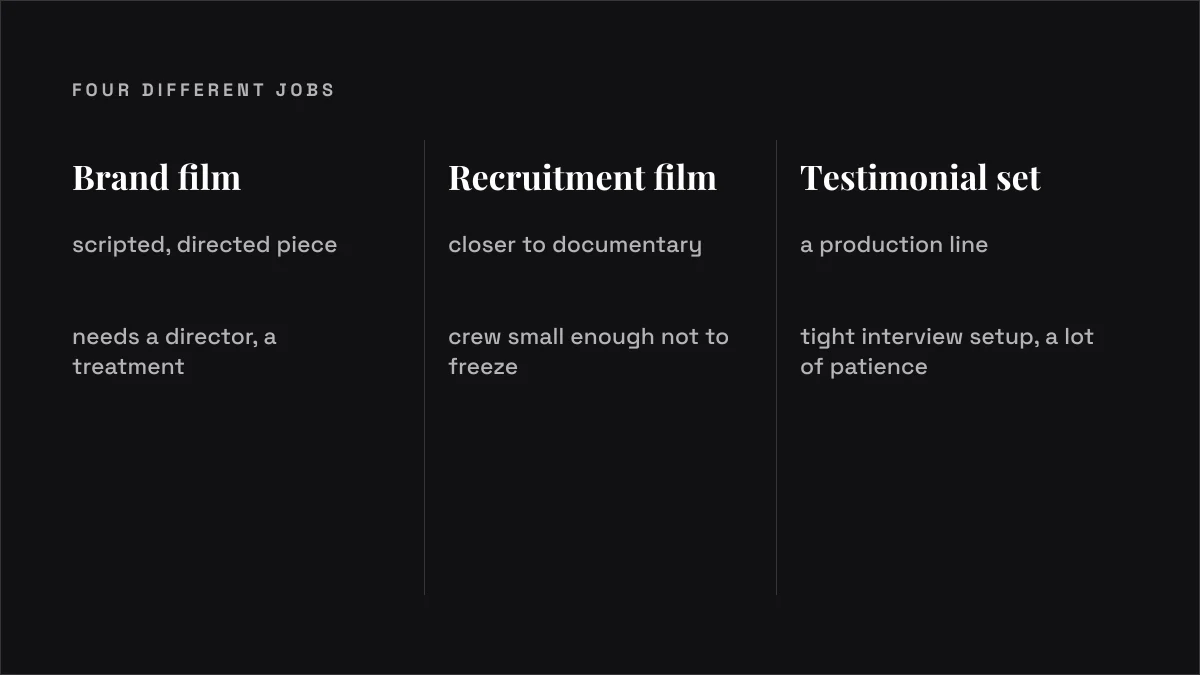
A brand film is a scripted, directed piece. It needs a director, a treatment, a location plan and a post schedule measured in weeks. A recruitment film sits closer to documentary: you are following real people and hoping they say something true, which means you need a crew small enough not to freeze the room. A testimonial set is a production line: several people, one location, a tight interview setup, and a lot of patience. An event film is reactive. You cannot schedule an event, you can only survive it.
Ask the company which of these four they have actually made, recently, and ask for the full film rather than the highlights. A company that makes beautiful brand films may be the wrong choice for a set of six customer testimonials in a single day, and the reverse is just as true.
Lead time follows the type. A testimonial set can be scoped in a fortnight. A brand film with a script, casting and locations will take a month or more before the first shooting day, and longer if the story is not settled. An event film has the date fixed for you, which is its own kind of pressure.
Ask who will be on the floor
The person who pitches is rarely the person who shoots. This is not dishonesty. It is how companies are built. The founder or the senior producer wins the job, then hands it to a crew. That is fine, but you should know the names before you sign.
Ask for the actual crew in writing: the director, the camera operator, the sound recordist, the producer on the day. If those names are not yet settled, ask when they will be. A company that cannot tell you who will be on the floor three weeks out is a company that has not scheduled the job yet.
Then check one thing. Will the director who pitched be at the shoot? On smaller jobs the answer is usually yes. On larger ones it is often no, and the person who arrives has read the brief but not written it. Ask directly, and do not feel awkward about it.
This is also where you find out whether the company is a production house with a bench of people or a single filmmaker with a network of freelancers. Neither is wrong. But they behave differently when a shoot day goes sideways, and you want to know which one you are buying.
Check the India leg of the job
Most of the corporate work I shoot for overseas clients happens without anyone from their side travelling. That is not a boast about my side of it. It is simply how the job is done now, and the gap between your evening and my morning turns out to be the most useful part of it.
If you are an overseas brand, the India leg is where a job quietly fails. Permissions for a private location, a factory, a government site or an airport are not things you arrange from another time zone. They are local work: a scout who knows the gate, a local liaison who knows which office signs the approval and how the process actually runs, a producer who knows how long the approval takes rather than how long the website says it takes.
Ask who handles the ground. Is it the company you are talking to, or a local crew they subcontract in the city where you are shooting? Both can work. But the answer changes who is accountable when the location falls through, and you want accountability to sit in one place.
A local crew starts the day already knowing things a flown-in crew spends its first day discovering. Which gate is open at six in the morning. Where the power sockets are. Which side of the building the light hits before noon. That knowledge is not a small thing. It is most of the reason to shoot with people who live there.
Which is also why nobody needs to fly in. If your brief is a set of interviews and B-roll at a site in Karnataka, the sensible answer is a Bengaluru-based company that has shot there before, not a team carrying gear through two airports to rediscover the obvious.
Work out the lead time before you work out the budget
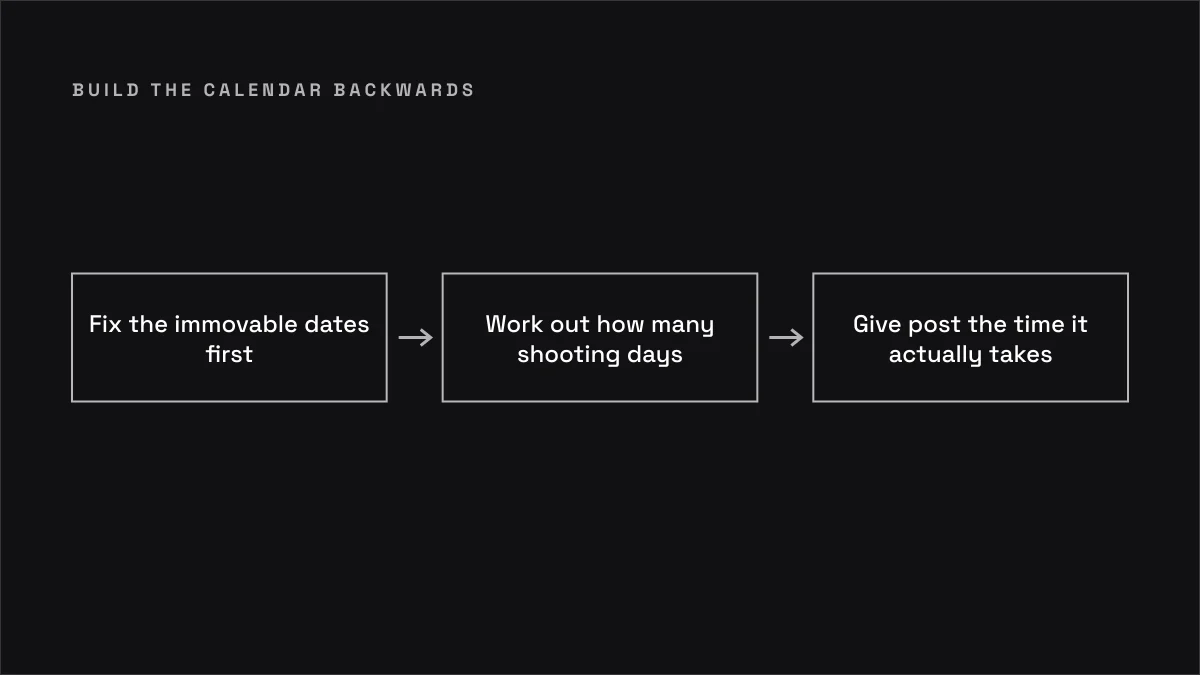
Airport filming and aerial work need the longest lead time of anything on an India shoot. Build the calendar backwards from those, and let everything else fall in behind.
Airport access is its own process. It needs an application, a security clearance, a sponsor inside the airport authority, and a fixed window that does not move for your convenience. Aerial work is similar: a drone permit for a site near sensitive airspace is not a same-week request. Neither is a shoot inside a working factory where production cannot stop for you.
So the method is this. Fix the immovable dates first. Then work out how many shooting days the story needs. Then give post the time it actually takes, which is longer than anyone wants to hear, especially if there are cut-downs, subtitles and multiple aspect ratios.
The step people get wrong is booking the shoot day first and discovering the permit problem afterwards. By then the location is booked, the talent has taken leave, and everyone is standing around waiting for an approval that is still in a queue.
Read the treatment, not the deck
A treatment shows whether they understood the brief. A deck shows whether they own a template. The difference is usually obvious within two pages.
A deck is about the company: the team, the clients, the awards, the pretty grid of logos. A treatment is about your film: the story, the structure, the visual approach, the locations, the people you will follow, the reason for each choice. It should be specific enough that it could only have been written for you.
Read the treatment for one thing. Does it answer the actual question in the brief, or does it answer a more comfortable question? If the brief asks for a recruitment film and the treatment describes a brand anthem with employees in it, they have not understood the job.
Treatments are cheap to write and expensive to get right. A company that sends a thin treatment is telling you something about how the shoot will go.
Ask for the boring samples
Full films, the uncut interview, the graded and the ungraded frame. This is where a company reveals itself, and almost nobody asks.
The full film, not the highlight. Watch ten minutes of it, not thirty seconds. Does the story hold? Does it drift? Do the interviews carry the weight, or does the edit paper over them with music?
The uncut interview is the most revealing sample of all. A good interview is made by the person asking the questions, not the person answering them. Watch how the interviewer listens. Watch whether they let a silence sit or fill it. Watch whether the subject looks relaxed or cornered.
The graded and ungraded frame is the quiet test. Ask for a still before and after colour. It tells you how much of the look is built on set and how much is rescued in post. Both are legitimate, but a company that leans entirely on the grade is a company whose lighting may be thin.
If they cannot send these, that is your answer.
Settle the money conversation early
Scope, revisions, music licensing, stock, travel and who pays for what. All of it agreed before the shoot, in writing, with the numbers in one place.
The conversation worth having early is not about the total. It is about the edges. How many rounds of revisions are included, and what happens after the third? Is the music licensed for the film only, or for paid media too, and for how long? If the shoot needs stock footage, who buys it and who owns the licence? If the location is outside the city, who covers travel and stay, and is that a fixed amount or a bill that arrives later?
These are the line items that turn a comfortable budget into an uncomfortable one. They are also the line items that are easiest to agree when everyone is still friendly.
I prefer a client to put the whole scope on one page and sign it than to trust a long email chain. One page is easier to hold people to. The chain is the argument that comes later.
Confirm the deliverable list in writing
The deliverable list is the part of the brief everyone skims and nobody forgets. Write it down and check it against the invoice.
Here is the checklist worth putting in front of a client before the first shoot day.
Aspect ratios: 16:9 master, 9:16 vertical, 1:1 square if social needs it.
Cut-downs: how many, and at what length (a 60-second, a 30-second, a 15-second bumper).
Subtitles: which languages, burnt in or as a separate file.
File formats: which codec, which resolution, which delivery platform.
Footage handover: raw footage or finished films only, and in what format.
Music and stock licensing: what is covered, for how long, and for which channels.
Ownership: who owns the finished film, the raw footage, and any outtakes.
Archive: how long the company keeps the files, and what it charges to retrieve them later.
The step people get wrong is treating the vertical cut-down as an afterthought. A film shot for 16:9 and cropped to 9:16 loses its framing. If you need vertical, say so before the shoot, so the camera can be set up for it.
Watch the first cut for structure, not colour
The first cut is for the story. Everything else can wait. Clients fixate on grade and music while the story is still broken, and by the time they notice, the edit is three revisions deep.
Watch the first cut with the sound off if you can. Does the film still make sense? Does it move? Does it say the one thing you needed it to say, early enough that a viewer who leaves after twenty seconds has heard it? If the answer is no, no amount of colour work will fix it.
Make your notes in two lists. One list is structural: this section is too long, this interview should come earlier, this point is missing. The other list is polish: the grade, the music, the lower thirds. Send the structural list first and wait for the next cut before you send the polish. Mixing them is how a film ends up with beautiful colour on a story nobody follows.
I say this as someone who loves a good grade. But the grade is the last thing that should be argued about.
Decide when to go elsewhere
Some jobs are simply not mine, and saying so early saves everyone a month. If you are running a multi-city campaign with several units shooting at once, a larger production house with a bench of producers and crews is the better choice. Running four simultaneous shoots is a logistics business, not a directing one, and you should hear that on the first call rather than three weeks in.
If you need a quick internal clip for a town hall next week, your in-house team should make it. It will be cheaper, faster and good enough, and the money you save can go into the film that actually needs a crew.
If you are shooting in a city I am not in, a local crew there will outshoot me on the ground every time. The person who knows the streets will always start ahead.
And if what you need is a library of stock footage of Indian offices and Indian streets, a stock library is the honest answer. Do not commission a shoot for footage that already exists.
I would rather lose the job to the right people than win it and deliver a film that should have been made by someone else.
Common questions
How do I compare corporate video production companies in India fairly?
Compare them on the same three things: a full film they have made, the crew names for your job, and a written scope with the revisions and licensing spelled out. The reel is the least useful of the three.
Can you shoot in India if our team is based overseas?
Yes, and most of the corporate work I shoot for overseas clients happens without anyone from their side travelling. The India leg is planned, crewed and delivered locally, with the time difference used deliberately rather than fought.
How far in advance should we book an India shoot?
It depends on the hardest thing in the job. Airport filming and aerial work need the longest lead time of anything on an India shoot, so build the calendar backwards from those dates and let the rest fall in behind.
What should be in the first cut review?
Structure, not colour. Check whether the story holds, whether the key point lands early, and whether any section runs too long. Send the polish notes only after the structure is settled.
Who should not hire you?
If you need several units shooting at once, an in-house team for a quick internal clip, a local crew in a city I am not in, or stock footage, hire those instead. I will tell you on the first call.
Before you sign anything, ask the company for one redacted call sheet from a recent shoot. Read it properly. If the permissions, the backup day and the crew names are all there, you are probably in safe hands.