
Is motion graphics a good career now that AI tools can draft the frames
A plain look at whether motion graphics is still a good career when AI can draft frames, and what the job actually asks you to sign off on.

A plain look at whether motion graphics is still a good career when AI can draft frames, and what the job actually asks you to sign off on.
A delivery spec sheet for a broadcast commercial lists one line that no AI tool can sign off on: the master file must be cleared for transmission, with all fonts and footage licensed for the territory. That line is not a formality. It is the reason the job still exists.
So is motion graphics a good career now that AI tools can draft the frames? Yes, with a condition attached that most career advice skips. This career is good if you stop selling frames and start owning the technical and legal weight of what actually goes out. Frames were never the whole job. They were the visible part.
The line that is not on the sheet
Look closely at that spec sheet and notice what it does not ask for. It does not ask for the most beautiful render. It does not ask for the cleverest animation. It asks for a master that will survive a broadcaster's technical review and a legal review, in a named territory, at a named duration, in a named codec, with paper behind every asset inside it.
Those are two different jobs. One is making something look good. The other is making something that can be transmitted, defended and paid for.
AI is getting very good at the first. It has no mechanism at all for the second. A tool cannot hold a licence. It cannot indemnify a broadcaster. It cannot look at a font and tell you whether the foundry's agreement covers broadcast use in the Gulf. That is a signature, and a signature needs a person who can be held to it.
What AI actually drafts
Be precise about the capability, because both the hype and the panic get it wrong. Current tools generate stills and short clips. They produce an image, or a few seconds of motion, from a prompt. Some of it is genuinely useful. A mood frame in ten minutes instead of a day is useful. A rough background plate to test a composition is useful.
What they do not produce is a timed, versioned, broadcast-ready sequence. They do not hand you a 30-second cut with a 15-second cut-down, a 10-second bumper, a 6-second bumper and four vertical social edits, all matched frame for frame, all carrying the same lower third, all with audio at broadcast loudness. That assembly is the work. Generation is one input to it.
There is also a quieter problem. Generated clips arrive without a paper trail. You do not know what the model was trained on, you cannot always trace a face or a logo, and you cannot certify that a frame does not contain a protected mark. For a personal project, nobody asks. For a brand's television buy, somebody always asks.
The broadcast delivery problem
Here is what a motion graphics artist actually signs off on at the end, and none of it is glamorous.
Technical: the codec and container are correct for the destination, the frame rate matches the house standard, the colour space is tagged and the levels are legal, the audio sits at the loudness the broadcaster specifies, the safe areas hold the text clear of the edges, and the file passes a QC check without a single dropped frame.
Legal: every font is licensed for the use and the territory, every piece of stock footage and music is cleared, every logo is used within the brand's own rules, and any recognisable person or place has the release it needs.
Versioning: the same approved graphic appears identically across every cut and every aspect ratio, so the client's brand does not wobble between the TV spot and the Instagram reel.
An AI draft does not remove any of that. It adds to it, because now there is one more asset in the chain whose provenance you have to establish before you can put your name to the master. A draft is a starting point. Clearance is the deliverable.
A worked example: the lower third
Follow one small graphic all the way, because the lower third is where the whole argument sits in miniature. A name and a title, sliding in at the bottom of the frame. Simple. Watch what it takes. This is an illustrative example, not a real brief.
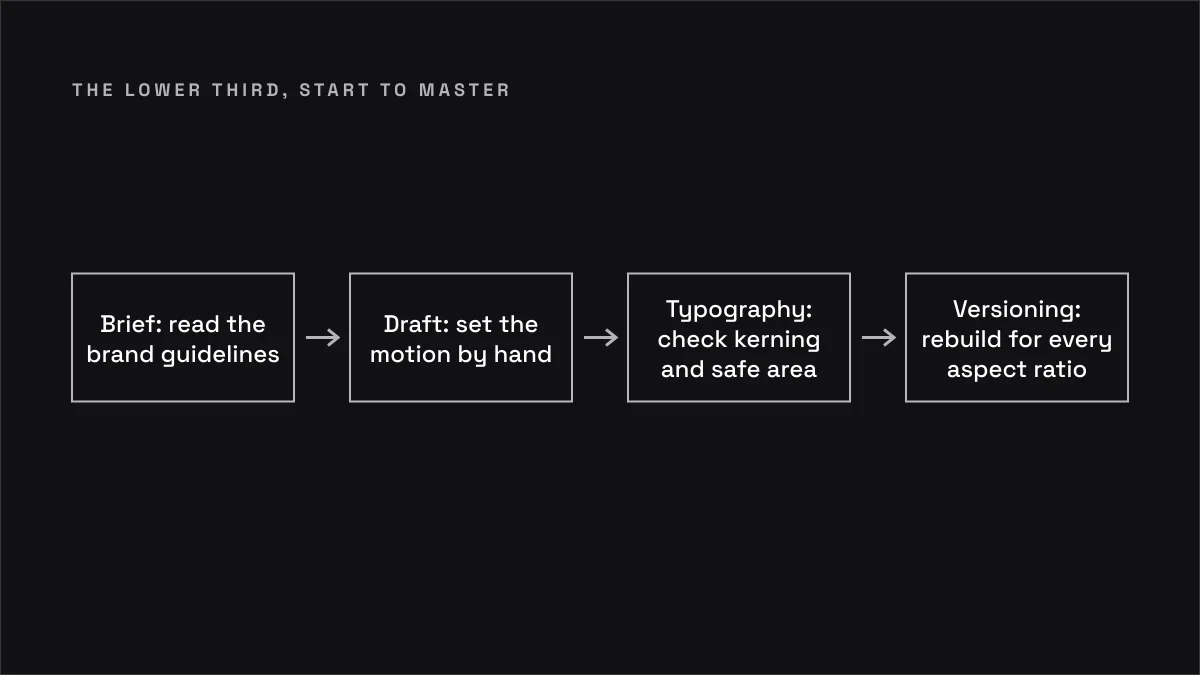
Brief. Say a client wants a lower third for a series of interviews. The brand has a typeface, a colour and a rule about how the logo sits. A designer reads the brand guidelines and decides the layout, the weight, the timing and the animation curve. AI can suggest layouts here, and some of the suggestions are decent. A human decides which one respects the brand and which one merely looks modern.
Draft. The designer builds the graphic in a compositing tool, or generates a texture or a background element with AI to save time. Either way, the motion is set by hand: how long the name holds, how it enters, how it leaves. Timing is a judgement about reading speed and rhythm, and it is not a prompt.
Typography. This name is set in the licensed typeface. The designer checks the kerning, checks that the title fits without wrapping awkwardly, checks that the text clears the safe area on a 9:16 version as well as a 16:9 one. A generated frame will happily put a name half off the edge. A person will not.
Versioning. Every aspect ratio and every cut length gets the same lower third rebuilt or re-laid. The client approves one, and the designer makes sure the approved one is the one that ships everywhere.
Clearance. The font licence is checked for broadcast and territory. Check the logo against the brand's own usage rules before it is confirmed. The interview subject's release is on file. The designer or the producer signs the delivery sheet.
Master. Encode the file to spec, check it for legal levels and loudness, and send it. The render was maybe a tenth of the job. Judgement, versioning and clearance made up the rest, and every one of those steps needs a person who can be held to it.
Why the job title survives
The role is not disappearing. It is moving. The centre of gravity shifts from making frames to directing them, building the systems that keep them consistent, and owning the delivery.
Direction means deciding what the motion should feel like and why, and being able to reject a generated draft that is technically fine and emotionally wrong. Systems means building a template, a set of rules, a component library that a whole campaign can run on without falling apart. Delivery ownership means being the person whose name is on the master when it goes to transmission.
That is a more senior job than it was five years ago, and a more technical one. People who move into it early will do well. The people who stay purely in frame-making will feel the floor move under them.
The junior problem
Now the honest part, the part the optimistic career pieces leave out. The entry-level frame-making is exactly what is being automated. The junior task of producing a clean, simple animation to a brief is the task a tool now does in minutes, and pretending otherwise helps nobody.
So the entry path changes. The old path was: get good at making frames, get junior work, learn the rest on the job. This new path asks you to learn the delivery side earlier, because that is where the durable value is and because it is the part the tools cannot touch. A junior who can also encode to spec, check a font licence and version a graphic across four aspect ratios is far more useful than one who can only animate.
It is a harder start. It is also a clearer one, because the skills that get you in are the skills that keep you in.
Motion graphics vs AI in a pitch
In a pitch, nobody serious is asking for AI instead of motion graphics. They are asking for two things at once: faster drafts, and the same accountability on delivery. The client wants to see options sooner and wants the final master to be as safe as it always was.
That is a good position to be in. Offer the speed of AI drafting for exploration, and pair it with a delivery process that carries the liability. The pitch is not "I use AI" or "I do not use AI". The pitch is "you will see directions faster, and the thing that goes to air will be correct and cleared". One without the other is either slow or unsafe.
Motion design vs AI in a studio
Inside a studio, the distinction that matters is between motion design and AI-generated assets. They are not the same kind of thing, and treating them as rivals muddles the argument.
An AI-generated asset is a piece of content: an image, a clip, a texture. Motion design is a system: how a brand behaves in motion, how its logo moves, how its type enters, what its transitions feel like, how all of that holds together across a campaign and a year. A system is resilient because it is a set of decisions and rules, not a single output. You can generate assets into a system, but the system is the thing the client is really buying, and it is built by people.
What a good career looks like now
Back to the main question. Is motion graphics a good career? Yes, but the career is broader and more technical than the version sold to students. It is less "I make things move beautifully" and more "I direct motion, build the systems it lives in, and own the master that goes out".
That is a bigger job, and a more defensible one. The beautiful motion is still the point, but it is now the visible tip of a longer process, and the process is what pays and what protects.
The skills that do not automate
Timing. Knowing how long a name holds so a viewer can read it, and how a cut should land. Timing is a human judgement about attention, and it is learned by watching and doing, not by prompting.
Typography. Setting type that respects the brand, fits the frame, clears the safe area and reads at broadcast speed. A generated frame will break type in ways a trained eye catches in a second.
Delivery specs. Knowing the codecs, the frame rates, the colour tags, the loudness standards and the QC checks for each destination. This is the unglamorous core, and it is the moat.
Client communication. Explaining why a draft is wrong, why a version must match, why a font cannot be used, and doing it in a way that keeps the project moving. Half the job is making decisions legible to people who do not work in the tool.
A numbered path in
- Learn one compositing tool properly. Depth in a single tool beats shallow knowledge of five.
- Learn typography and layout as craft, not decoration. Study how type behaves in motion and at speed.
- Learn the delivery chain end to end: encoding, frame rates, colour, loudness, safe areas, QC.
- For the legal layer, font licensing, stock clearance, releases and brand usage rules, ask a lawyer or a producer. That is not your call to improvise.
- Build a small system, not just a showreel: a template set that holds up across 16:9, 9:16 and 1:1, and version it cleanly.
- Use AI for drafting and exploration, and be honest about where its output enters the chain.
- Get a delivery signed off under supervision, then own one yourself. The signature is the milestone.
When the machine is the wrong tool
AI drafting is a bad fit in several clear cases, and every one of them comes back to delivery. Any broadcast delivery, where provenance and clearance must be provable, is a bad fit because a generated clip arrives without the paper trail the master needs. Any brand system is a bad fit, because consistency across versions matters more than any single frame, and a tool that generates one frame at a time does not hold a system together. Any graphic carrying licensed type or a regulated claim is a bad fit, because the provenance question is exactly the one the tool cannot answer; whether that exposure is real for your project is a question for a producer or a lawyer, not for me. Any project where a client needs a named person accountable for the master is a bad fit, because accountability is the one input no model supplies.
In those cases a human motion graphics artist is not a nostalgic choice. It is the correct hire, because the job is delivery and liability, and only a person can carry both. When a client needs a full motion system across many deliverables, a specialist studio with a producer and a legal reviewer is the better hire than a freelancer working alone; a freelancer is the right call for the single graphic, the one-off cut or the small campaign.
The person who should skip this career
This career is a poor fit for one kind of person, and it is worth saying so plainly. If you want to be left alone to make beautiful frames and hand them to somebody else to ship, this is the wrong career now. That person used to have a place. The place is closing, because the frame-making is the part that gets automated and the shipping is the part that does not.
If you are willing to learn the codecs, the licences, the versioning and the client conversation, and to put your name on a master at the end of it, the career is good and getting better. Talent is not the split. It is appetite for the unglamorous half.
What the trade press is missing
Read the public coverage and a pattern shows up. Animation World Network runs a jobs roundup of dozens of openings. Campaign Brief reports an AI ad platform, built by engineers from big-name backgrounds, launching its own motion graphics studio. Raindance publishes a piece by someone with twenty years in animation on why AI reminded them why they started. The conversation is about tools, and about who is adopting them.
What the coverage mostly skips is the delivery chain. Headlines are about generation, not about the clearance, the codec, the versioning and the signature at the end. That gap is where the career actually lives, and it is why the trade press can report a tooling shift and still miss the reason the job persists.
The part nobody wants to learn
Nobody enters motion graphics to learn codecs and safe areas and font licences. They enter to make things move. But the unglamorous work is the actual moat, and it is the part that does not automate, because it is not a rendering problem. It is a judgement and accountability problem.
The people who learn it early stop competing with the tool on frame-making and start owning the thing the tool cannot do. That is the trade. It is not exciting. It is durable.
The line that is now on the sheet
Go back to the spec sheet. That line about the cleared master is still there, and it matters more now than it did before, because there are more assets in the chain and more ways for provenance to go missing. The render line, the one about the picture looking right, was never the hard part. The signature line was.
AI can draft the frames. It cannot sign the sheet. That is why motion graphics is still a good career, and why the people who will do well are the ones who move from making the frames to owning the weight of what goes out.