How to Film Customer Stories So the Customer Does the Talking
A practical method for filming customer stories so the customer's own words carry the film, from choosing the right person to the questions you ask before the camera arrives.

A practical method for filming customer stories so the customer's own words carry the film, from choosing the right person to the questions you ask before the camera arrives.
How do you film a customer story so the customer does the talking? You keep the camera on them, you ask short questions, and you resist every instinct to put your own words in their mouth.
That is the whole method. Almost everything below is about defending it, because every stage of a customer stories video pulls in the other direction. A brief wants a message. Marketing wants a claim. An edit should sound like the website. Your job is to hold the customer's own words in place until the film is finished.
Who is actually talking in your customer story?
The customer should be talking, in their own words, unprompted, and the film's job is to get out of the way. If you can swap the customer's name for another customer's name and the script still works, you have made a brochure with a face on it. That is the failure mode, and it is common.
I have shot and edited customer story films for GoDaddy. The ones that worked had a person saying something I would never have written for them. A phrase that was slightly wrong, or too plain, or more specific than the brief asked for. That is the material. You cannot manufacture it, and you cannot improve it in the edit without killing it.
Take a hypothetical: a customer describes the problem in a phrase nobody in the room had used, and that phrase becomes the spine of the piece. The product appears, but it appears as the thing that fixed her problem. She is the witness. Software is the exhibit. I am inventing that example to make the point, not reporting a shoot.
This is the distinction that decides everything downstream. An actor reads a script. A witness tells you what they saw. You want the second one. And the second one is harder to direct, because you are not directing at all. You are hosting.
Start with the person, not the product
Your brief should name a human being with a specific story, not a logo and a list of features. When the client sends a one-page brief with three value pillars and a request for "a customer who loves the product", send it back with a question: who is the person, what did they used to do, and what changed?
Ask for two or three names, not one. The first name a company offers is usually the person who is most senior or most media-friendly, and that is rarely the best witness. A better candidate is often a manager or a team lead who had to solve the problem personally and can still remember being annoyed by it.
What makes someone good on camera: they speak in specifics, they have opinions, and they have not been media-trained. A media-trained person gives you answers shaped like press releases. They pause in the right places. They say "great question". It is polite and it is unusable.
An opinionated person will say the rollout was messy for the first month. That sentence is gold. It buys you the audience's trust for the rest of the film, because nobody believes a story where nothing went wrong.
The questions you ask before you ever book a camera
This is the step people get wrong. They take the brief, book the camera, arrive on the day, and hope the interview will produce itself. It sometimes does. Usually it does not, and you spend the edit trying to build a story out of pleasant generalities.
Do a pre-interview call with the customer first. Twenty to thirty minutes, no camera, no client on the line if you can manage it. Tell them it is a conversation, not the interview. Then ask about the problem, not the product.
What I actually want from that call:
- The situation before. What were they doing, and what was breaking?
- The objection. What nearly stopped them buying or adopting it?
- It was the moment it changed. A specific day, a specific meeting, a specific number that moved.
- The people around them. Who else was in the room, and who should be in the B-roll?
- The words they use. I write down their phrases verbatim, because those phrases are the script.
The step people get wrong is treating the pre-interview as a scheduling call. It is the research. By the end of it you should know the three or four sentences the film will be built around, and you should know which ones will not survive contact with the client's comms team so you can plan around them.
If the customer is guarded on the call, that is information. It usually means the client is in the room with them, or they are worried about saying something wrong. Fix that before the shoot day, not on it.
Write a shot list around the words you expect
Prepare a loose shot list from the pre-interview, so the coverage supports what the customer will say without scripting them. Loose is the operative word. You are not writing a script. You are writing a list of things that will probably need to be on screen while they say it.
If the customer told me the problem was a weekly report that took two people a full day, I list the desk, the two people, the screen with the report on it, the moment of handing it over. If they told me the fix changed how their team talks in the morning meeting, I list the morning meeting, if the client will let me film one.
Then I add the things I always want regardless of the story. Hands. A walk through the door. We shot the workspace from a low angle. The team in the background, slightly out of focus, doing actual work. The product in use, not on a launch screen.
What you do not do is write lines for the customer. The moment you hand someone a sentence, you have hired an actor at a witness's rate. If a phrase from the pre-interview is strong enough, you can remind them of it on the day and ask them to say more about it. You do not ask them to repeat it.
Set the room so the customer forgets the camera
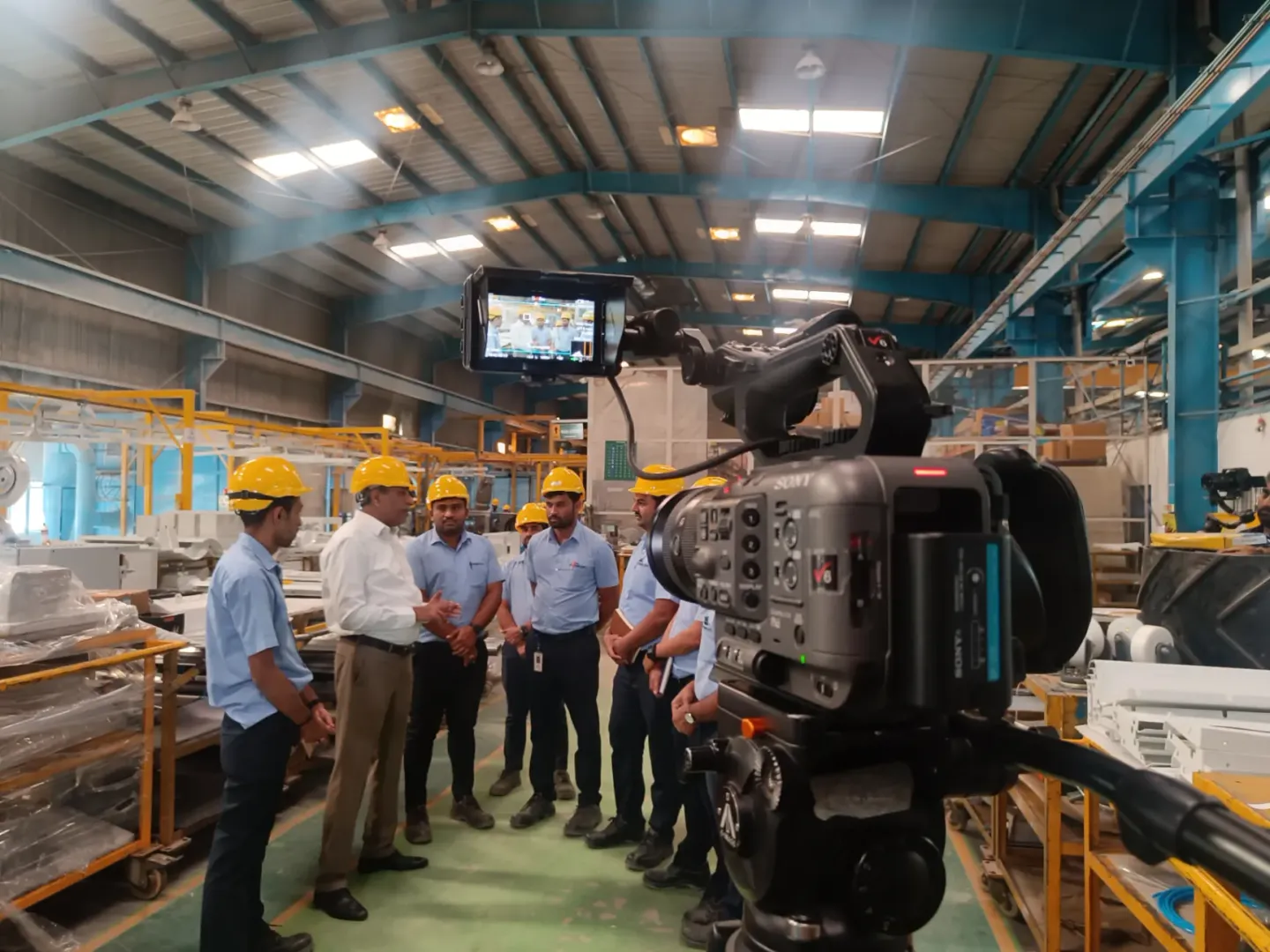
The room should feel like a meeting, not a set. That starts with where you put people. Interviewer sits close to the customer, slightly off the camera's axis, at eye level. The camera sits to the side of the interviewer, not between them and the customer. The customer looks at a person, never at a lens.
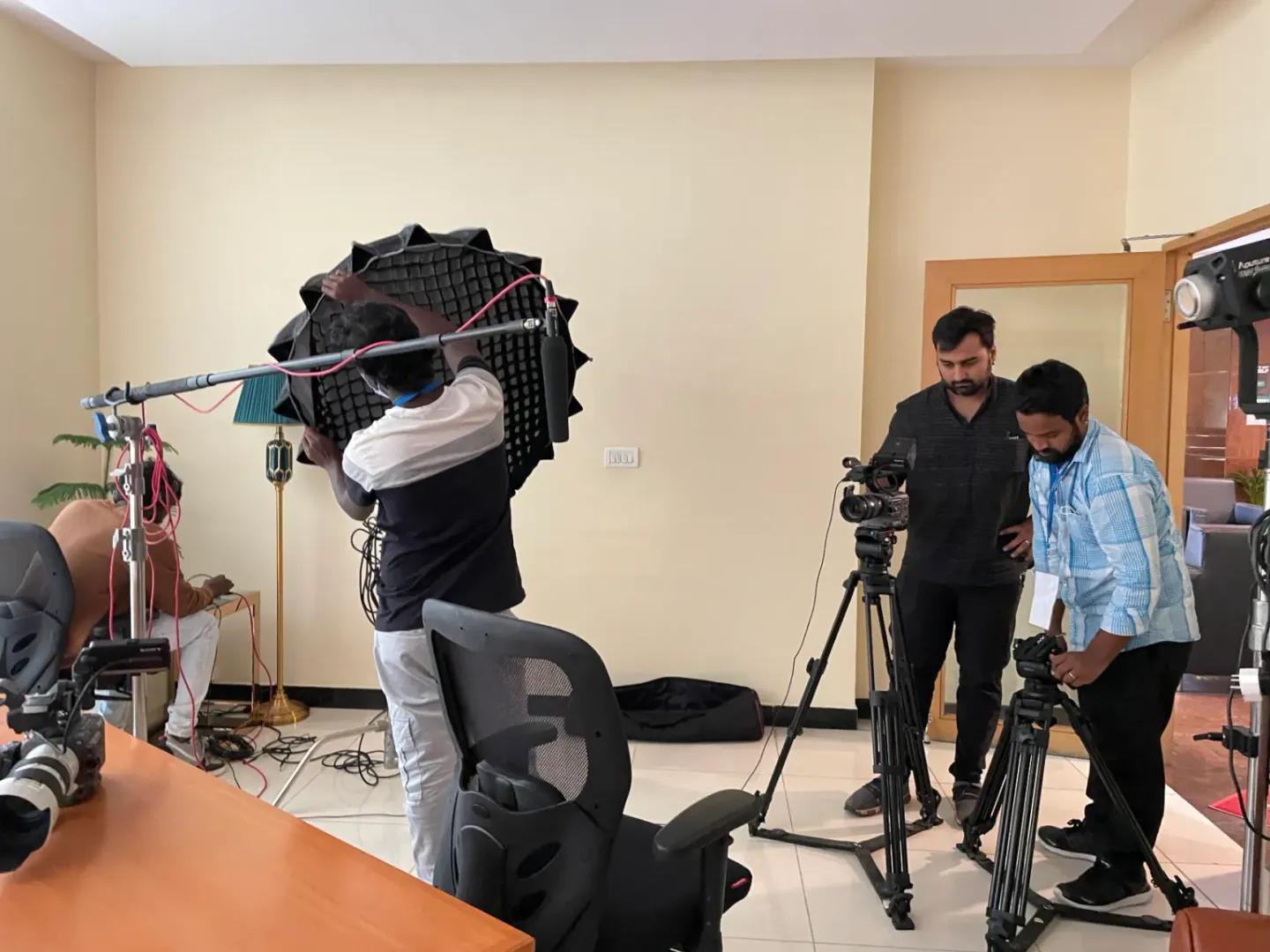
Keep the crew small. Every additional person in the room is another reason for the customer to perform. A two-person crew, one on camera and one asking questions, is usually enough. If you need a second camera for a safety angle, lock it off and leave it alone.
Light for the face, not for the room. Window light is fine if it is consistent and you can control it. If you are fighting mixed colour, fix it in the grade, but do not spend an hour building a set the customer has to sit inside and feel strange in. The strange feeling reads on camera.
Put the customer's own things in frame. Their mug. Their whiteboard. A printout sits on the desk. A room that looks like their room makes them talk like themselves. A room that looks like a studio makes them talk like a spokesperson.
The interview itself: shut up and let them finish
This is where the film is won or lost, and the winning move is silence. Ask a short question. Then stop talking. Let the answer arrive, and let it keep arriving after the first pause.
The instinct, especially when you are also producing, is to nod and say "right, and then..." halfway through the answer. Do not. The best sentence in the interview is often the one that comes after the customer has already given you a usable answer and is now thinking out loud. If you interrupt, you lose it.
Ask for the anecdote, not the summary. "Tell me about the day the report broke" gets you a story. "How would you describe the benefits of the platform" gets you a press release. The first question is the one that makes the film.
When they give you a summary, ask "can you give me an example of that?" When they give you an example, ask "what did you do next?" Keep the questions under ten words. Shorter questions get longer and better answers.
Let silences sit. A pause of four or five seconds feels enormous in the room and invisible in the edit. It is often where the person decides to say the true thing instead of the safe thing.
Get the B-roll that proves they mean it
The talking head makes the argument. The B-roll proves the person actually lives in it. Anyone can say the tool changed their workflow. Only the footage of the workflow can show it.
Suppose the customer says her team stopped chasing updates. Then you film the update. The screen, the notification, the person glancing at it and moving on. That shot does more work than a sentence about efficiency, because it is evidence rather than a claim.
What to shoot besides the interview:
- Hands on the keyboard, hands on the product, hands signing something.
- The workspace wide, then tight, then detail. Build a sequence you can cut in any order.
- The product in real use, on a real screen, with the customer's actual data if they will allow it.
- Customer with their team, walking, talking, pointing at a screen.
- A clean plate of the room, empty, for transitions and cutaways.
The step people get wrong is treating B-roll as filler. It is not. It is the second witness. If the customer says the team was skeptical, the B-roll should show the team. If they say it was chaos at first, the B-roll should show a desk that looks like chaos, or better, the person who lived through it.
Get the B-roll on the same day, in the same clothes, in the same room. A cut between a talking head in a blue shirt and B-roll of the same person in a different shirt a week later is a small lie the audience feels without knowing why.
Do not let your client's marketing team rewrite the quotes
The review stage is where a customer story gets sanded down into a brochure. Someone in marketing reads the transcript, sees a sentence that is honest but slightly awkward, and "tidies" it. The tidied sentence is grammatically better and completely dead.
My rule is that the customer's phrasing is the asset. You can cut a sentence. You can move a sentence. You cannot rewrite it into marketing language and still call it a customer story. The moment the customer sounds like the website, the audience stops believing them.
So protect the phrasing early. In the pre-interview, flag the sentences you plan to use. In the edit, show the client the transcript with the chosen quotes highlighted, so they see the argument before they see a cut. It is harder to rewrite a quote when you have already agreed it is the one that carries the film.
Where I am not the authority: legal and the client's comms team decide what claims can be made. A customer story is a testimonial, and a testimonial is a claim with a face on it. If the customer says something about performance or compliance that the company cannot stand behind, that decision sits with the client's legal team, not with me. I will argue for the phrasing. I will not argue about whether the claim is allowed. Get that conversation done before the shoot if anyone suspects a number will be quoted, because a claim pulled after the interview takes the best sentence of the film with it.
Now the concession that actually costs something. If the client's in-house team has a better relationship with the customer and can get a more honest answer, use them, and I mean hand it over: no camera of mine in the room, no cut of mine at the end, just my notes on the pre-interview and the questions to ask. A familiar face gets a truer sentence than a stranger with a better sensor, and if that is the trade, the film wins and I lose the job. I would rather say that plainly than pretend I can always be the right person in the room.
The edit: cut for the argument, not the timeline
Build the cut around the customer's clearest statements, not around the order they said them. An interview is a timeline. The film is an argument. They are not the same shape.
I cut and grade in DaVinci Resolve Studio. The first pass is audio only. I pull the strongest statements into a document, put them in an order that makes an argument, and only then start laying pictures against them. If the argument works with the sound off, you have a film. If it only works when you read the transcript, you have a podcast with B-roll.
A common client note at this stage is "can we keep that sentence too?" Usually the answer is no, and the reason is pace. Every sentence you add costs the audience a little attention. The film should have one argument, made three or four times, in the customer's own words. A fifth repetition does not strengthen it.
Handle the client who wants every sentence kept by showing them two cuts. One with everything, one with the argument. They will feel the difference in the room. Then let them decide, because it is their film, and sometimes the longer cut is right for an internal audience even if it is wrong for the website.
The grade should serve the witness. Natural skin tones, a room that looks like the room, nothing that draws attention to the camera. The customer is not a product shot. Do not light them like one.
Cut-downs and where the film actually lives
The main film is rarely the one that gets watched most. Deliver the 16:9 master, then cut vertical 9:16 and square 1:1 versions for social, each built around a single statement rather than trimmed from the long cut.
A vertical cut-down is not the main film cropped. It is a different film with one job: stop the thumb and land one sentence. Pick the sentence first, then shoot and cut for it. If the main film is three minutes, the vertical is twenty to forty seconds, and it should still be the customer talking.
Subtitles are not optional. Most social viewing happens with the sound off, and a customer story with no captions is a customer story nobody hears. Burn them in for social, supply a sidecar file for the website, and check the line breaks by eye. Auto-captions get names and product terms wrong, and a misspelled customer name undoes the whole point.
For quick internal clips, the client's in-house team is often the better choice. They know the internal channels, they can turn a clip around in a day, and they do not need me to export a version for the intranet. I would rather hand them the footage and the transcript than pretend I am the fastest route to a Slack clip.
Common questions
How long does a customer story film take?
Most of the schedule is not the shoot. The pre-interview, the scheduling, the customer's availability and the review rounds take the bulk of it, and the shoot itself is a small slice of the whole. If the customer is travelling or legal review is involved, expect the calendar to stretch. Ask the client early how many people have to sign off on the cut, because that number decides the timeline more than anything I do on set.
Does the customer need media training?
No, and I would rather they did not have it. Media training teaches people to answer the question they wish you had asked. A customer story needs the opposite: a person answering the actual question, in their own words, including the awkward parts. A short pre-interview call does more good than a training session.
What does a customer story film cost?
I do not quote rates here. Ask me with a scope in hand: how many customers, how many locations, how many cut-downs, and how many rounds of review. Those four answers move the number more than anything else. Client's finance team is the right authority on what fits their budget, and I would rather build the scope with them than guess at a figure on a page.
Can we use our own footage?
Often yes, and it can help. Existing event footage, phone clips of the team, screen recordings of the product in use. The test is whether it matches the film's look and whether it is honest. A phone clip of the actual launch day is worth more than a polished stock shot of a generic office. What you should not do is fill the gaps with stock footage of people who are not your customer.
Who owns the final cut?
The client owns the delivered film, and the client has final say on the cut. I care about the craft, meaning the grade, the sound and the picture, and I will argue for those. The argument of the film belongs to the client and the customer. One thing I will push back on is rewriting the customer's words into marketing language, because that is the thing that makes the film stop working. If the client wants a scripted version, that is a different film, and it should be briefed as one.
Checklist before the shoot day
- Two or three customer names, not one, and a reason for each.
- A pre-interview done, with the phrases written down verbatim.
- The three or four sentences the film will be built around, agreed in your own notes.
- A loose shot list built from those sentences, plus hands, walk, workspace, product in use.
- The customer's own room, or as close to it as the client will allow.
- A small crew, and a clear answer on who is asking the questions.
- Same clothes and same room for the B-roll as for the interview.
- The client's sign-off chain named before the edit starts.
- Subtitles planned, and the vertical cut-down built around one sentence.
So the question I keep asking myself on every one of these jobs is not whether the film looks good. It is whether the person in it would recognise themselves in the cut. If they would, you have probably protected the thing that mattered. If they would not, you have made a very polished piece of marketing, and you should be honest about which one you were hired to make.